The importance of the recitation of the Divine Office can not be measured as we embark on the contemplative life. If one is not able to pray it morning and evening start with one prayer at a convenient time in your day. The prayers have a way of calling you to peace, where you can meet
Jesus in loving union. He waits for you and He is a 24
Hrs a day 7 days a week kinda guy. He will not disappoint you.
On particularly difficult days you are consoled by the fact that the whole religious and consecrated church is praying with you.
I always find that there will be a few lines of scripture or the words of a Saint that will speak to my heart .
God bless you all,
Margaret of Souls for Jesus
The Divine Office
(Liturgy of the Hours)
Presence of God– O Jesus, vouchsafe to associate my poor prayer with the great Prayer of the Church.
MEDITATION
The liturgy accompanies Holy Mass with the recitation of the Divine Office [Liturgy of the Hours] which, as Mediator Dei teaches “is the prayer of the Mystical Body of Christ, addressed to God in the name of all Christians and for their benefit, by priests, other ministers of the Church, and religious, who are assigned this task.” The great dignity of the Divine Office lies in the fact that it is not a private prayer, but the official public prayer of the Mystical Body of Christ, whose members do not pray alone, but with Christ their Head. “When the Word of God assumed human nature, He intoned in His earthly exile the hymn which is sung in heaven through all eternity. He joined to Himself the whole human community and united it with Himself in the chanting of this hymn of praise” (Mediator Dei).
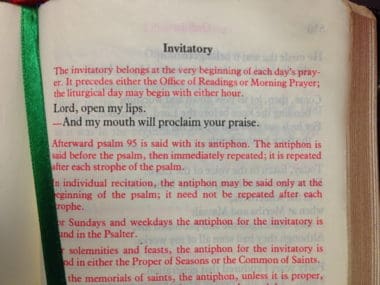
In the Divine Office, “Jesus prays with us as our Priest; prays in us as our Head…. Let us recognize then,” says St. Augustine, “our voice in His and His voice in us.” What a wonderful gift! Jesus, the Son of God, associates our poor, miserable prayers with His great precious Prayer.
Divine OfficeAlthough the Divine Office [Liturgy of the Hours] is of obligation only for priests and religious who are charged with it by the Church, it can be said that it is the prayer of the whole Christian people, in the sense that it is addressed to God “in their name and for their benefit.” It is therefore highly praiseworthy for the laity to try to participate in it in some way; for example, the recitation of Vespers [Evening Prayer] on feast days, as well as of Prime [previously Early Morning Prayer] and Compline [Night Prayer].
Furthermore, they can offer to God at every hour of the day and night the great Prayer of the Church, for their own special intentions and individual needs. In this way they can make up for the deficiencies and the brevity of their own personal prayers. Even in the midst of daily occupations, each one can unite himself from time to time by pious aspirations with the “perpetual praise” which the Church sends up to God in the name of all Christians.
COLLOQUY
“O Lord, Your ears are not turned toward our lips, but toward our heart; they are not open to the speech, but to the life of him who praises You.
“I sing with my voice to awaken piety within me; I sing with my heart to please You…. Let not my voice be alone in praising You, but may my works also praise You. Grant that I may not cease to live a good life, so that I may praise You without interruption.
If my tongue must be silent sometimes, let my life speak to You; Your ears will not be attracted by my voice, but may You attend to my heart.
“I shall not confine my praise to my voice, but I wish my praise to come from my whole being! Let my voice sing, let my life sing, let all my works sing. And if I must sigh, suffer, and be tempted here on earth, I hope that it will all pass away and the day will come when my praises will not fail. My voice may fail, but not my heart.
“It is better for me to use my strength in praising You, than to take breath to praise myself. It is impossible to faint in praising You. To give You praise is like taking food. The more I praise You, the stronger I become, because You are always giving me Your sweetness, You, the object of my praise.
“Help me, then, to praise You, by my voice as well as by my mind and by my good works, so that, as You exhort me in the Scriptures, I may sing to You a new canticle. To the old man, the old canticle; to the new man, the new canticle. If I love the things of the world, my song is old; I must love the things of eternity. Your love is ever new and eternal, ever new because it never grows old. Sin is what has made me grow old; rejuvenate me by Your grace” (St. Augustine).

 “According to the Will of the Heavenly Father, as the mother of Him who loves you, I am here with you to help you to come to know Him and to follow Him.